Distance vs. Displacement
Mastering 1D Motion at Panda Academy
Understanding the difference between distance and displacement is fundamental to mastering kinematics. While they both measure length, they describe motion in very different ways.
- Distance: The total length of the path traveled by an object, regardless of its direction.
- Type of Quantity: Scalar (it has magnitude but no specific direction).
- Value: It is always a positive numerical value.
- Path Dependency: It depends on the actual path taken between two points.
- SI Units: Meters (m) or centimeters (cm).
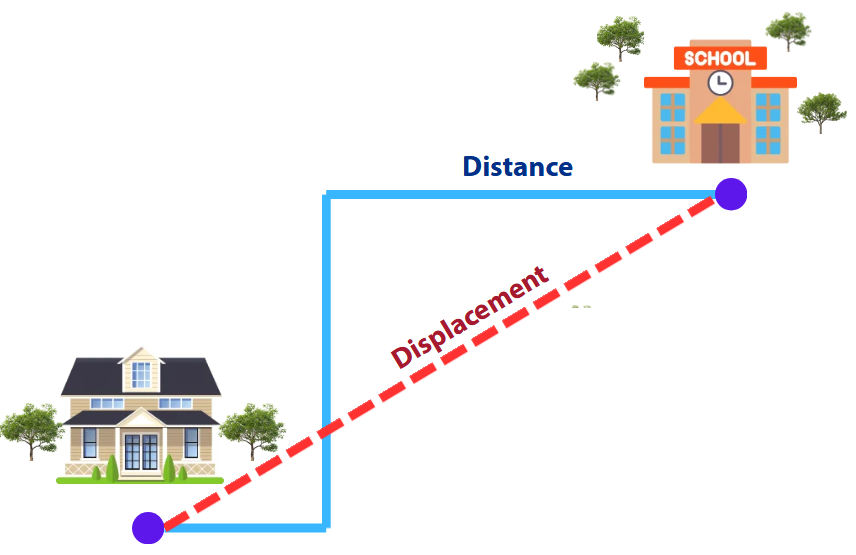
- Displacement: The straight-line change in an object’s position from its starting point to its final destination.
- Type of Quantity: Vector (it includes both magnitude and a specific direction).
- Value: It can be positive, negative, or zero (if the object returns to its starting point).
- Path Dependency: It is independent of the path taken; it only considers the initial and final positions.
- SI Units: Meters (m) or centimeters (cm).
Key Comparison
| Feature | Distance | Displacement |
|---|---|---|
| Definition | Total ground covered | Shortest path between two points |
| Quantity | Scalar | Vector |
| Direction | Not required | Required |
| Formula | Sum of all path segments | Final Position – Initial Position |
Example 1: Joshua biking to school
Imagine Joshua biking to reach school.
1. Calculating Total Distance:
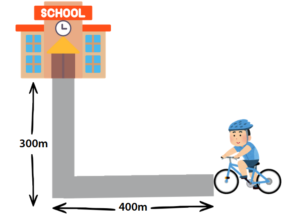
Distance is the total path covered.
Distance = 400m + 300m = 700 meters.
2. Calculating Displacement:
Displacement is the straight-line distance from the start to the end point.
Displacement = √(400² + 300²) ≈ 500 meters towards north west
Example 2: Swimmer crossing a pool
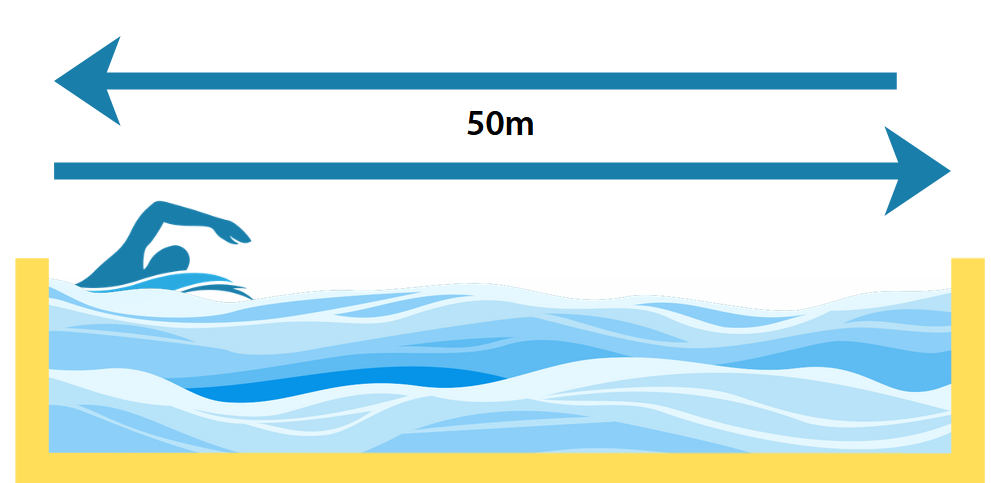
A swimmer swims from one end of a 50-meter pool to the other, then turns around and swims back to the starting point.
1. Total Distance: 50m (to the other end) + 50m (back) = 100 meters.
2. Displacement: Since the swimmer ends up exactly where they started, displacement = 0 meters.
Practice Quizzes
Q1: A man has to go 50 m due north, 40 m due east and 20 m due south to reach a field.
A. What distance he has to walk to reach the field?
B. What is the displacement from his house to the field?
Click to see Answer
Answer:
A. Distance: Total path = 50m + 40m + 20m = 110 m.
B. Displacement: Net North-South = 50m (N) – 20m (S) = 30m (N). Net East = 40m (E).
Displacement = √(30² + 40²) = √(900 + 1600) = √2500 = 50 m.
Q2: An athlete runs exactly once around a circular track with a radius of 50m. What is the distance and displacement?
Click to see Answer
Answer: Distance = 2πr ≈ 314.16m. Displacement = 0m (since the starting and ending points are the same).