Speed vs. Velocity
Mastering 1D Motion at Panda Academy
Speed vs. Velocity
- Speed: The rate at which an object covers distance. It is a scalar quantity.
Average Speed = Total Distance / Total Time
Instantaneous Speed: The speed at a specific moment.
- Velocity: The rate at which an object changes its position. It is a vector quantity (includes direction).
Average Velocity = Displacement / Time
Instantaneous Velocity: The velocity at a specific moment.
Example: Speed and Velocity of the Swimmer
Let’s use the Round Trip example. Suppose the swimmer takes 100 seconds to swim the full 100 meters (back to the start).
[PLACEHOLDER: Insert Image showing the swimmer’s path (same as Distance & Displacement page)]
1. Calculating Average Speed:
Total Distance = 100m, Total Time = 100s.
Average Speed = 100 m / 100 s = 1 m/s
2. Calculating Average Velocity:
Total Displacement = 0m (since they are back at the start), Total Time = 100s.
Average Velocity = 0 m / 100 s = 0 m/s
Conclusion: Even though the swimmer was moving fast, their average velocity is zero because they ended up exactly where they started!
Practice Quizzes
Position-Time Graph
The graph below illustrates the motion of a particle along the X-axis as a function of time.
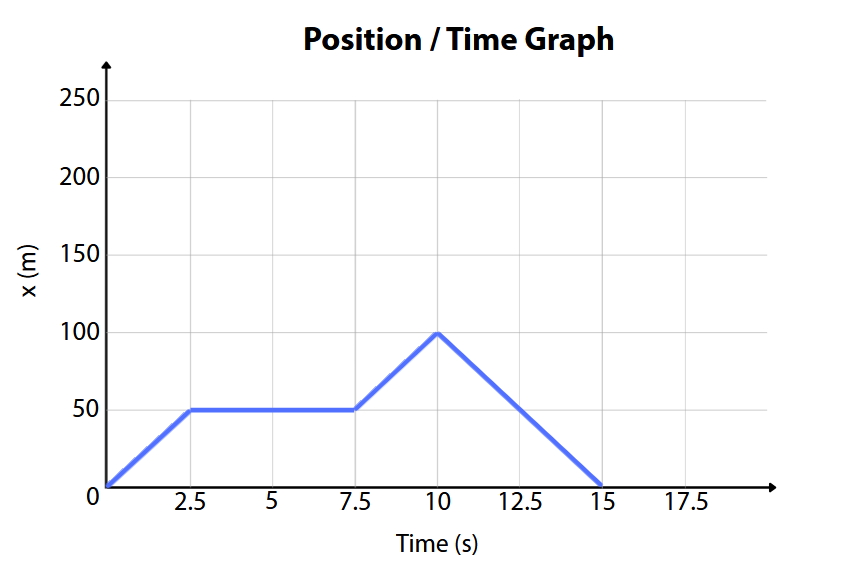
Q1: The image above shows a particle going along the X axis as a function of time.
A. Find the average velocity during 0 to 10 sec.
B. Find the instantaneous velocity at 2, 8, and 12 sec.
Click to see Answer (Based on Graph Analysis)
Answer Guide:
A. Average Velocity: (Position at 10s – Position at 0s) / 10s.
B. Instantaneous Velocity: Calculate the slope of the line at each specific time interval (v = Δx/Δt).
Q2: A car travels 50 km North and then 50 km South in 2 hours. What is its average speed and average velocity?
Click to see Answer
Answer: Average Speed = 100 km / 2 h = 50 km/h. Average Velocity = 0 km / 2 h = 0 km/h (since displacement is zero).