Frequently Asked Questions
Q: Is Deceleration the same as Negative Acceleration?
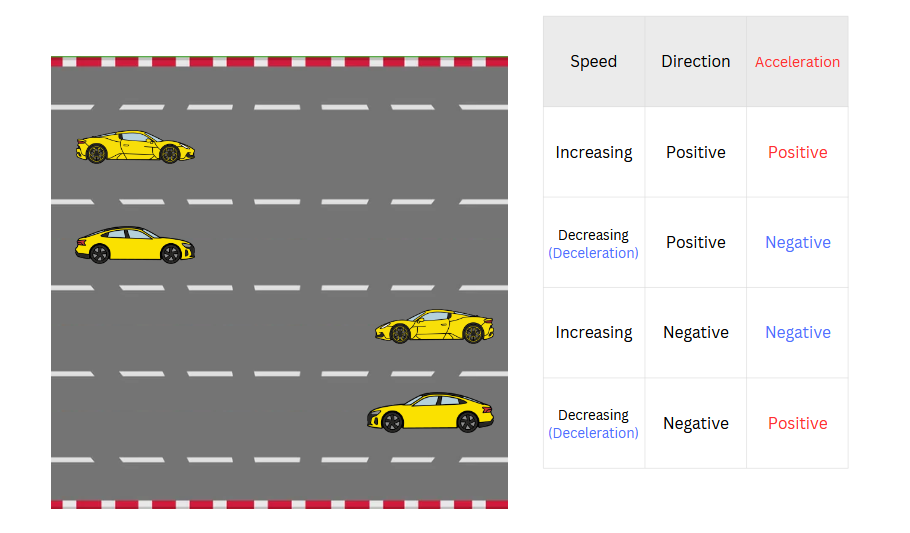
A: Not necessarily! Deceleration always means an object is slowing down, while Negative acceleration simply refers to the direction.
- Moving positive (+) and slowing down = Negative (-) acceleration.
- Moving negative (-) and slowing down = Positive (+) acceleration.
- Moving positive (+) and speeding up = Positive (+) acceleration.
- Moving negative (-) and speeding up = Negative (-) acceleration.
More questions will be added here soon!
Acceleration
Mastering 1D Motion at Panda Academy
Crucial Concept: Speed vs. Acceleration
It is important to remember that moving fast does not necessarily mean an object is accelerating. For example, a race car traveling at a constant speed of 300 km/h has zero acceleration. Acceleration occurs only when there is a change in velocity. If the velocity is constant, the acceleration is zero, regardless of how high the speed is.
Understanding Acceleration
Acceleration is defined as the rate of change of velocity with respect to time. As a vector quantity, it encompasses both a change in speed and a change in direction.
Common Units: While the SI unit is m/s², acceleration can also be expressed in other units such as cm/s² or km/h² depending on the context of the motion.
Types of Acceleration
- Constant (Uniform) Acceleration: Occurs when the velocity of an object changes by equal amounts in equal time intervals.
- Average Acceleration: The total change in velocity divided by the total time interval.
aavg = (vf – vi) / Δt
- Instantaneous Acceleration: The acceleration at a specific moment in time.
Example: Constant (Uniform) Acceleration
See the table below for an example of an object with a constant acceleration of 2 m/s²:
| Time (s) | Velocity (m/s) | Acceleration (m/s²) |
|---|---|---|
| 0 | 0 | – |
| 1 | 2 | 2 |
| 2 | 4 | 2 |
| 3 | 6 | 2 |
| 4 | 8 | 2 |
Deceleration
Deceleration refers to a decrease in the magnitude of velocity over time—commonly known as “slowing down.”
Real-World Examples of Deceleration
1. Braking a Car: Imagine a car traveling at 20 m/s. When the driver applies the brakes, the car comes to a complete stop in 4 seconds. The acceleration is -5 m/s², which is a deceleration of 5 m/s².
2. Upward Projectile Motion: When a ball is thrown vertically upward, gravity pulls it downward with an acceleration of -9.8 m/s². As it rises, its speed decreases until it momentarily stops at the highest point. This slowing down during the ascent is a classic example of deceleration.
3. Landing an Aircraft: Upon touchdown, an aircraft must rapidly reduce its speed from hundreds of kilometers per hour to zero. Using wheel brakes, spoilers, and reverse thrust, the plane undergoes significant deceleration to stop safely within the runway length.
Practice Problems
Problem 1: A car increases its velocity from 10 m/s to 30 m/s in 5 seconds. What is its acceleration?
Click to see Answer
Answer: 4 m/s²
Calculation: (30 – 10) / 5 = 20 / 5 = 4 m/s²
Problem 2: A sprinter starts from rest and reaches a velocity of 12 m/s in 3 seconds. Calculate the acceleration.
Click to see Answer
Answer: 4 m/s²
Calculation: (12 – 0) / 3 = 12 / 3 = 4 m/s²